Add your promotional text...



Forgive and Let Go: How to Reclaim Your Peace and Freedom
Forgive and let go—not to excuse the past, but to reclaim your peace. Discover the stages of forgiveness, self-forgiveness, and true emotional healing.
SELF-LOVE, HEALING & INNER WORK
Soul Sisters Tarot
6/9/202510 min read


Forgive and Let Go: How to Reclaim Your Peace and Freedom
This guide is part of our Self-Love Journey, where we explore emotional healing, self-compassion, and gentle practices that help you build a deeper and more supportive relationship with yourself.
Forgive and let go: It's not about excusing hurtful behavior; it’s about choosing peace over pain. This emotional journey of forgiving and letting go isn’t about them; it’s about freeing yourself.
Did you know that 62% of American adults say they need more forgiveness in their personal lives? Let’s be honest, this is not just any other number; this is a wake-up call for all of us. We carry emotional scars—resentment, guilt, betrayal—that weigh us down day after day. Forgiving and letting go isn’t about making excuses for someone’s behavior or forgetting about the past.
Instead, it’s a powerful act of self-care designed to free you from that burden, so you can begin living with inner peace, clarity, and freedom. We’ve all been hurt by people we trusted, loved, or depended on. Whether it’s a betrayal, harsh words, neglect, or trauma, the emotional wounds left behind often become a silent weight we carry every day. But what if you could release that weight, not for their sake, but for yours?
Forgiveness is not about letting someone get away with what they did to you. It’s about freeing yourself. You don’t forgive because the person deserves it—you forgive because you deserve peace. Forgiveness is a vital part of self-love and healing, which we discuss more in our self-love and healing article.
“There are times when you can’t forgive, and that’s normal too. Forgiveness is not mandatory, but letting go is. And some things don’t deserve forgiveness. We don’t have to forgive, but we have to let go. Because letting go frees us and gives us peace of mind. And yes, letting go without forgiveness seems even harder to do. That’s also normal. In this article, we talk about forgiveness and letting go, but the most important part is to let go. Let go of anger, guilt, resentment, and hurt. This holding a grudge thing is really just you letting your physical and mental health take a hit for something you don’t want to do - let go, stress is the number one killer in this world, and it’s sneaky.” - Caitlin
Often, resentment is tied to repeated thought patterns, which is why learning about breaking negative thinking patterns for a healthier mindset can support the forgiveness process.
🪷There are some reasons why it’s not so easy to forgive and let go.
Forgiveness feels unnatural when the pain is still raw. Anger and resentment often feel justified, like armor protecting our vulnerability. Holding on feels safer than letting go. And sometimes we fear that forgiving means excusing the behavior or forgetting the harm. It doesn't.
Letting go also includes releasing the need to constantly put others first, especially when people-pleasing begins to disconnect you from your own needs.
Forgiveness can be hard because it challenges the ego, awakens deep emotional wounds, and forces us to confront the complexity of human behavior, both others’ and our own. For deeper emotional healing, many people turn to shadow work as a way to face and integrate hidden emotions.
✨Stages of Forgive and Let Go: Your Path to Emotional Healing
Forgiveness is a journey, and like any journey, it’s usually not linear at all. It comes in stages, and sometimes you go back in those stages before you can move forward. Let’s be honest, it’s definitely not easy. Letting go of old pain can bring powerful emotional releases. For some people, this process can temporarily feel like a healing crisis as the mind and body process unresolved emotions.
All those hateful feelings
This is where it begins—rage, betrayal, injustice. We get stuck in pain, we replay the event over and over, we cry til our body starts to shake, we start to hate, we harden ourselves. This stage is natural but toxic if prolonged.
Even the smallest part hurts
Behind the anger is the real wound. The sadness, the disappointment, the emotional injury. Acknowledging the hurt is key. Also, it’s vital to acknowledge your emotions, your wounds, and maybe even most importantly, the fact that this really happened to you. After letting ourselves feel all that, we begin to heal.
Time for healing
Healing is the shift. It's where we process what happened, why it hurt, and how it's impacted our lives. We begin to release the tight grip the event has on us. This can take time, reflection, and courage.
The last part: letting go
Forgiveness does not always mean reconciliation. But this stage is where we either rebuild relationships or make peace with letting them go. Either way, we come back to wholeness within ourselves.
⚠️ Common Mistakes When Trying to Forgive and Let Go
Forgiveness is powerful, but it can also be misunderstood. Here are some common mistakes people make on this journey:
1. Expecting instant relief.
Forgiveness is not a switch you flip. It’s a process. Sometimes you’ll feel free one day and triggered the next. That’s normal.
2. Forgiving too quickly.
Sometimes we rush to forgive because we don’t want to feel the pain. But skipping the anger and sadness stage only buries it deeper. Emotional healing requires honesty.
3. Confusing forgiveness with reconciliation.
You can forgive someone and still choose distance. You can forgive and still have boundaries. Letting go doesn’t mean letting them back in.
4. Waiting for an apology.
You may never get one. And if your peace depends on someone else’s awareness, you’ll stay stuck.
5. Forgetting self-forgiveness.
Sometimes the resentment we carry is toward ourselves. Forgiving yourself is often the most important step in emotional healing.
Forgiveness is not about becoming passive. It’s about becoming free.
🌿Forgive and Let Go: The Real Benefits
When we forgive, we reclaim power over our own lives. This power is a real thing. Additionally, there are numerous physical, emotional, and spiritual benefits to be gained when we forgive and let go. Let’s see what they are:
Improved mental health and emotional stability.
Reduced anxiety, depression, and stress.
Stronger relationships (even with those not involved in the hurt).
Better heart health and immune function.
Higher self-esteem.
Greater inner peace and the ability to live in the present.
I think that it is safe to say that forgiveness is a gift to your entire being.
“Also, holding on to hurt, pain, or whatever someone caused you, it’s causing you stress. And in my opinion, stress is the number one thing that causes so many health problems. If I’m being honest, probably people who hurt you don’t even care that they hurt you, maybe they don’t even know. So, really letting things go is good for you, and holding a grudge is bad for you, not for them; they might not even feel a thing towards you. It’s the harsh truth.” - Caitlin
🙏Forgive and Let Go: Who to Forgive?
Your Parents
If we consider their own life story, characteristics, and their experiences, they really did the best they could, honestly. So let it go, let go of all the past hurt, don’t let them or anyone else hold power over you anymore. Whether it was abuse, neglect, or just unmet expectations, many of us carry unhealed pain from our upbringing. Forgiving your parents doesn’t mean saying it was okay—it means deciding that their choices won’t define your future.
Someone Who Hurt You
This can be a partner, friend, colleague, or stranger. You may never get closure or an apology, but you can still free yourself from the resentment.
Yourself
Often, the hardest one to forgive. Past mistakes, regrets, shame. But self-forgiveness is essential if you want to move forward. You don’t have to define yourself by your past or what happened to you in the past. You are who you choose to become now, because your choices truly make you who you are. Think of it this way - you really did the best you could considering everything.
Part of letting go also involves recognizing the ways you may have abandoned yourself in the past and gently choosing to show up for yourself differently.
If you’re struggling with this, our complete guide on how to learn to love yourself step by step may help you reconnect with compassion.
“Forgiving yourself is truly the hardest one. Sometimes, we are not even aware that we should forgive ourselves. You really can’t change the past, so don’t hold your past mistakes over your head. What’s done is done; next time, just try to make a better choice. And that’s how you learn.” - Caitlin
🫶How to Forgive and Let Go: Practical Steps & Self-Forgiveness Tips
Easier Said Than Done
Yes, forgiveness is hard. But not forgiving is harder. It keeps you stuck in the past. Start where you are. You don’t need to feel ready—you just need to be willing.
Commit to Letting Go
Believe it or not, it’s all about choosing to forgive, even if you don’t yet feel it fully. Keep reminding yourself: I am doing this for my own freedom.
Try Some Empathy and Compassion
Put yourself in the other person’s shoes. Try to understand where they are coming from and what might have caused their hurtful behavior towards you. Hurt people often hurt people. Empathy doesn’t excuse—it liberates.
Try Some Exercises
Reflect on the cost of holding onto anger.
Visualize the pain leaving your body;
Write about how forgiveness could make your life better.
Practice saying: “I choose to let go.” Even if it feels unnatural at first.
🪷 A Gentle Practice to Help You Forgive and Let Go
If you don’t know where to begin, start small:
Take 5 slow breaths. Inhale peace. Exhale tension.
Place your hand on your heart and say:
“I am ready to release what no longer serves me.”Ask yourself:
“What is holding me back from emotional healing?”Repeat softly:
“I choose peace over resentment.”
You don’t have to feel it fully yet. Sometimes the choice comes before the feeling
🌼 Signs You’re Ready to Forgive and Let Go
Forgiveness cannot be forced. It’s something you grow into. Sometimes you don’t even realize you’re ready until you notice small shifts inside yourself. Here are some gentle signs that you may be ready to forgive and let go:
You no longer feel intense anger when you think about what happened.
You can talk about it without your body reacting strongly.
You feel tired of carrying the resentment.
You’re more focused on your peace than on being right.
You start asking, “How can I heal from this?” instead of “Why did they do this?”
Being ready doesn’t mean you’re completely healed. It just means your heart is opening slightly. And that small opening is enough.
🌙Forgive and Let Go: Best Practices for Emotional Healing
Forgiveness Letter
Write a letter to the person who hurt you, this can be you or someone else, and remember, you don’t have to send it or show it to anyone. Express everything you need to say. Then end the letter with a statement of forgiveness—when you're ready.
Journaling
Use journaling to:
Express raw emotions;
Identify emotional triggers.
Acknowledge the impact of the hurt.
Consider the other person’s perspective;
Write forgiving affirmations like:
“I release this pain.”
“I choose peace over anger.”
If you need structure, you can use journal prompts for mental health and self-discovery to guide your reflections.
Meditation and Visualization
Try guided meditations focused on letting go. Visualize the scenery where your pain leaves your body as a dark smoke, leaving your body with each exhale. Visualize yourself feeling light, whole, and free. Breathe in peace. Breathe out the past.
Grounding practices can also help during emotional release — especially if you feel overwhelmed — and you can learn more about how to ground yourself spiritually here.
If you feel like you need more practice, we have a Self-Love Workbook that has a whole chapter on forgiveness and letting go. There are lots of exercises and meditations there. You are not alone in this.
🕯️Forgive and Let Go Ritual: Release Pain and Find Peace
Set aside a quiet time. Light a candle. Write a forgiveness letter to someone who hurt you (it can also be you). Pour your heart out—every hurt, every unspoken word.
Then read it out loud. Let yourself feel it.
When you're done, burn the letter (safely). And when the paper turns to ask, whisper quietly:
“I release this. I release the pain. I am free.”
Close with deep breathing. Imagine how each breath you take fills you with love, peace, and strength.
This is your turning point.
“It’s such a simple ritual, but I have tried it many times, and I can say from my own experience that it works. Yes, you may have to do it many times, but even the first time, it will make you feel lighter. And then, every time you feel that those hurtful feelings are not gone and keep coming up, just do the ritual. It is suggested to journal, write forgiveness letters, and meditate as well. It’s a journey, so it will take time. Give yourself that time.” - Caitlin
❓ Forgive and Let Go: Frequently Asked Questions
What does it truly mean to forgive and let go?
To forgive and let go means releasing the emotional grip the past has on you. It doesn’t mean excusing behavior or pretending it didn’t hurt. It means choosing your peace over prolonged pain.
How do I forgive someone who never apologized?
Forgiveness is not dependent on the other person. It’s an internal decision. You forgive for your own emotional healing, not because they earned it.
Can I forgive someone and still keep my distance?
Yes. Forgiveness does not require reconciliation. You can forgive and still maintain boundaries to protect your peace.
Why is self-forgiveness so difficult?
Because we often hold ourselves to impossible standards. We replay mistakes and attach shame to them. But self-forgiveness is essential for growth. You did the best you could with the awareness you had at that time.
How long does it take to forgive and let go?
There is no timeline. Some wounds take months. Some take years. The goal isn’t speed—it’s honesty and emotional healing.
What are the real benefits of forgiving?
Forgiveness reduces stress, supports mental health, improves relationships, strengthens self-esteem, and brings inner peace. Letting go is not weakness—it is self-care at its highest level.
💖Why Forgiving and Letting Go Is a Gift to Your Mind, Body & Spirit
Forgiveness is not a weakness—it’s one of the most courageous and liberating choices you can make. Forgiveness is a part of the art of self-love. Whether you're healing from deep betrayal or letting go of small, lingering resentments, the act of forgiving opens the door to peace, emotional clarity, and spiritual freedom. It's not about denying what happened or waiting for others to change; it's about reclaiming your power, your joy, and your life.
If you're unsure whether you're moving forward, you may want to explore the subtle signs of emotional healing and how to recognize real progress.
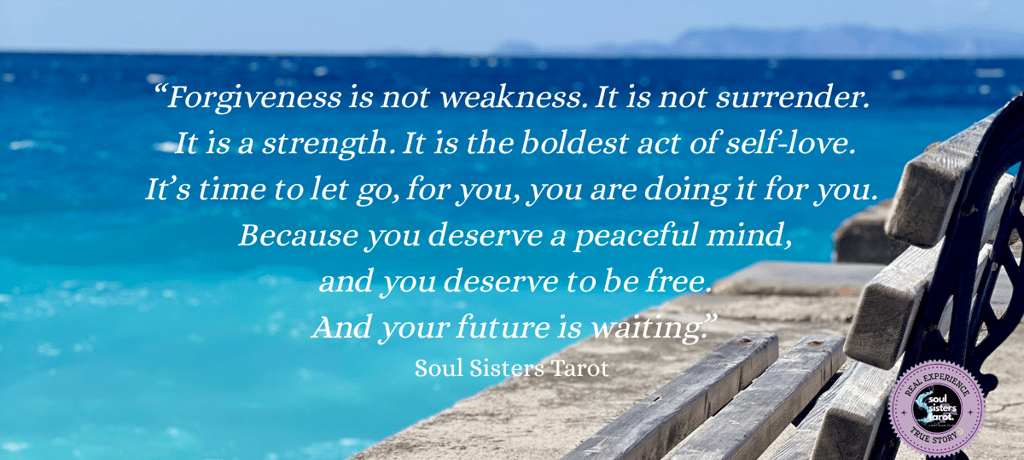
The forgiveness journey may not be easy, that’s for sure. But think about the freedom it brings, and this is worth every step. Remember, when you forgive and let go, you’re not doing it for them, you are not making excuses for them, but rather you are doing it for you, because you are worth the freedom.
If you feel called to explore your healing journey more deeply, you can discover our journals, self-love tools, and spiritual guidance inside Sisters Creation, where we share the resources we have created to support inner growth.
With love,
Caitlin & Gerly,
Soul Sisters Tarot
Soul Sisters Tarot
A Soft Place to Grow.
Join our weekly newsletter
© 2026. All rights reserved.
Inspirational Coaching OÜ
sisters@soulsisterstarot.com